fbpx accountarrow-down-linearrow-downarrow-left arrow-right arrow-up closedownload emailFacebookgrid-view instagramlinkedin list-view location notch-bottomnotch-topphonepinterestplay scroll-altscrollsearchtwitterwhatsappyoutube

CPR bus

Get Onboard: Learn Lifesaving CPR Skills

Fewer than one in 10 people survive an out-of-hospital cardiac arrest. But when bystanders act quickly, starting CPR and using a defibrillator, a person’s chances of survival more than double.

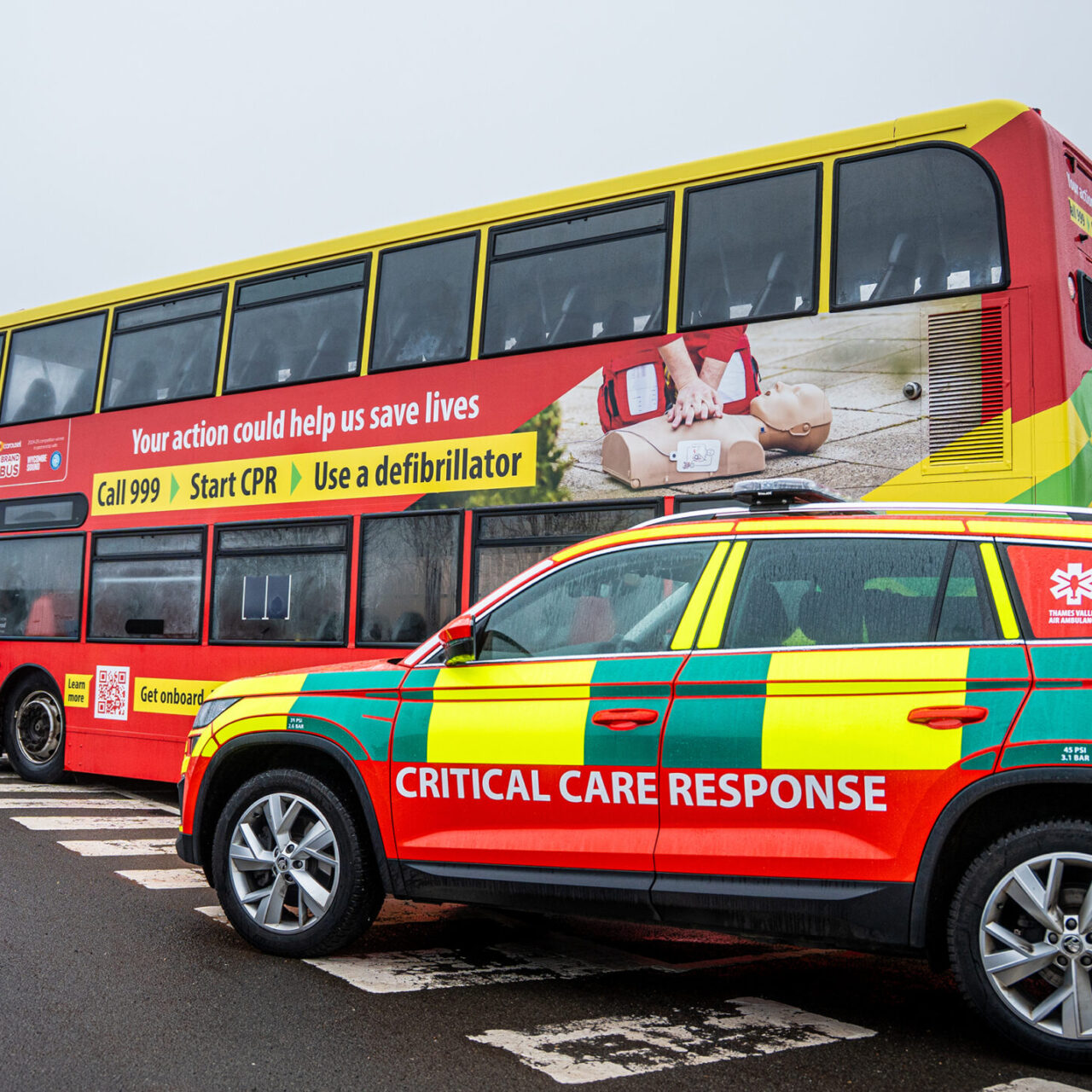
When asked, only one in three people within our region said they would feel confident performing CPR. We’re determined to change this. That’s why we’ve worked with Carousel Buses – as part of their Brand the Bus competition – to create a CPR bus, designed to spread awareness and educate the community on vital lifesaving skills.

Our doctors and critical care paramedics bring advanced skills and specialist equipment to the scene of an emergency. By learning how to perform CPR, you help give us the best possible chance of saving a life when we arrive.

We hope you never need to use the information on this page. But if you do, your actions could help save a life.
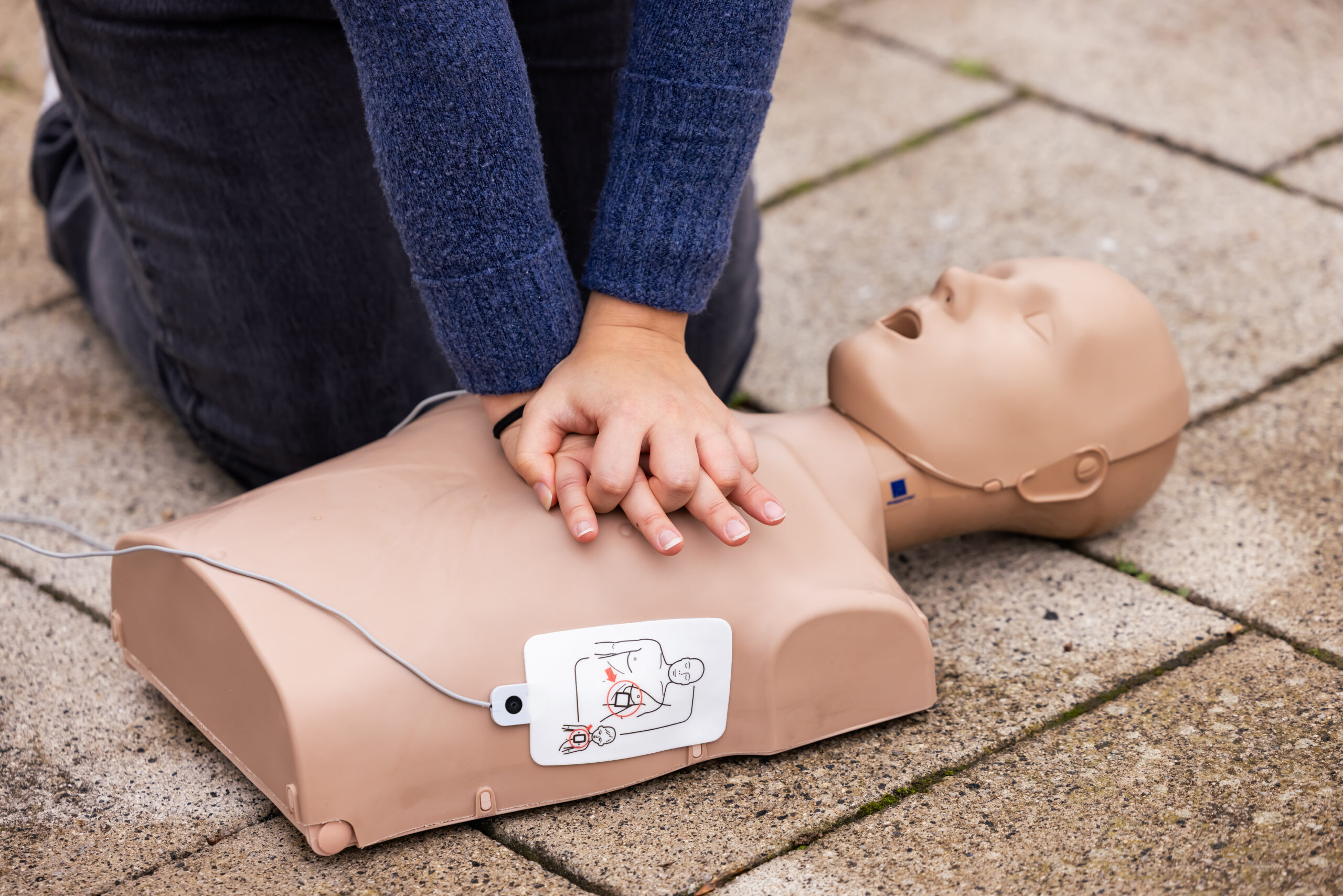
How to perform hands-only CPR

When someone suffers a cardiac arrest and their heart stops beating normally, every minute matters.

Step One: Call for help

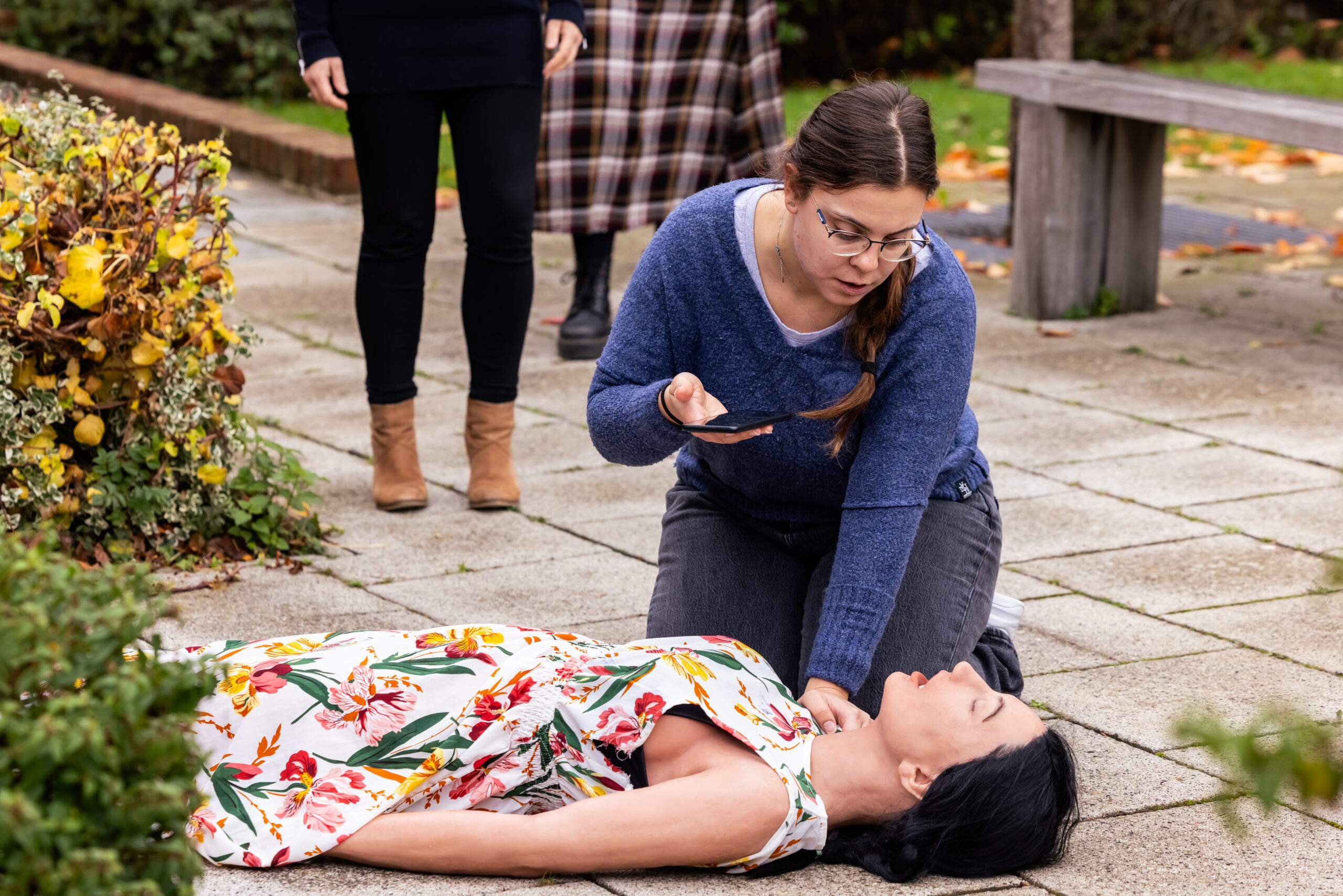
If you find someone collapsed, make sure it’s safe to approach. If they are unresponsive or not breathing normally, call 999 immediately and ask for an ambulance.

Step Two: Start CPR

Use the hands-free speaker on your phone, so that you can start CPR whilst speaking to ambulance control. If someone else is nearby, ask them to find and bring a defibrillator if available.

Step Three: Interlock your fingers

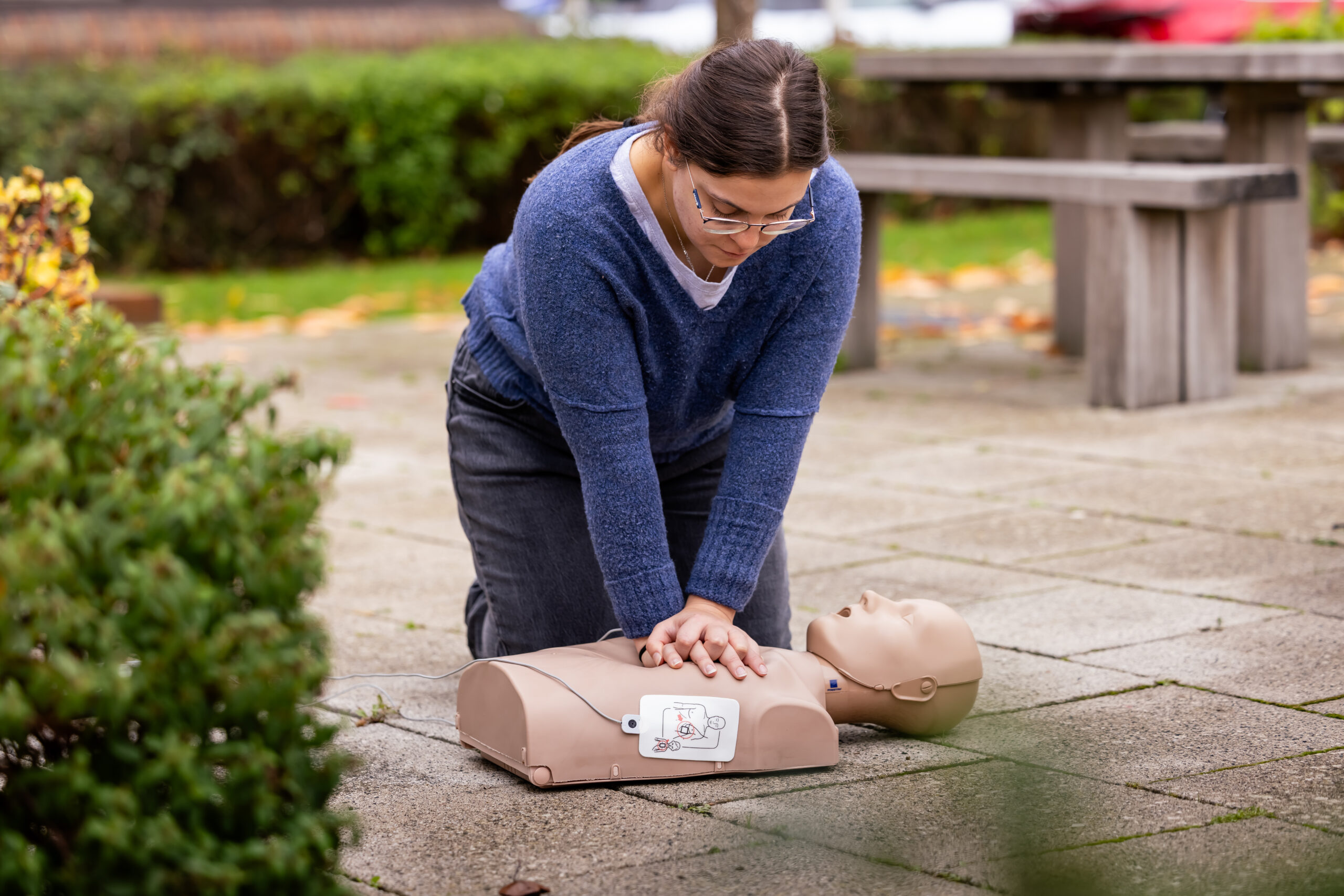
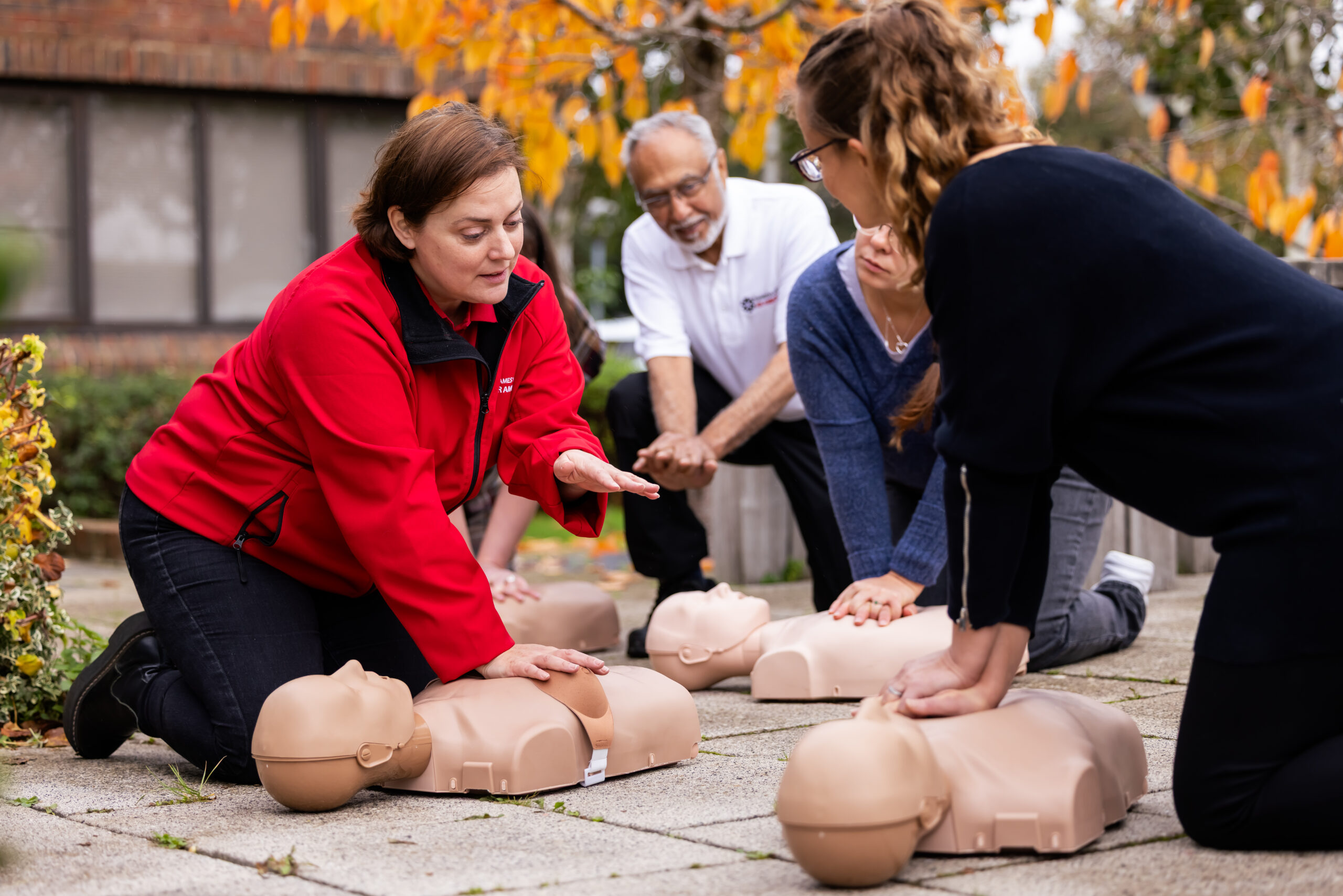
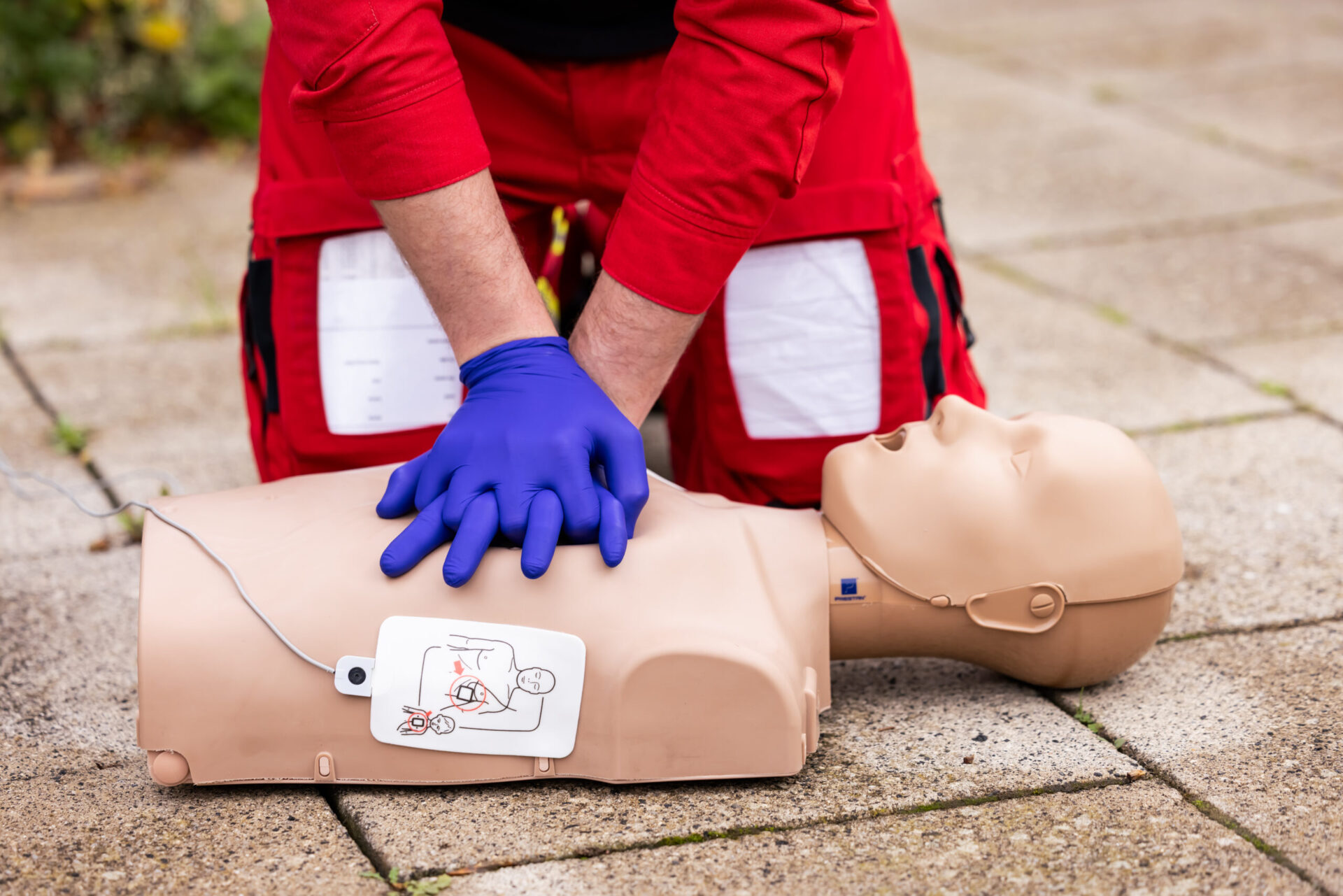
Kneel next to the casualty and place your hand in the centre of their chest. Place the palm of your other hand on top of the first and interlock your fingers. Keep your arms straight and lean over the casualty.

Step Four: Give chest compressions

Push down hard then release fully twice per second. Don’t stop. Do this at a rate of 100 – 120 times a minute.

Step Five: Continue CPR

Continue to perform CPR until emergency help arrives and takes over, a defibrillator is ready to be used, or the person starts showing signs of life and begins to breathe normally.

Bystander approaching casualty ready to perform CPR
Hand placement for CPR, showing interlocked fingers on centre of chest
Bystander performing lifesaving CPR on a training manikin

How to use an AED (Defibrillator)

An AED (Automated External Defibrillator) is a small, portable device that can save someone whose heart has stopped. It works by delivering a controlled electric shock to help the heart start beating normally again. AEDs are designed for anyone to use, even without training, and they guide you step by step.

Step One: Turn on the AED

Switch the device on and follow the spoken instructions. The AED will guide you through each step.

Step TWO: Expose and prepare the chest

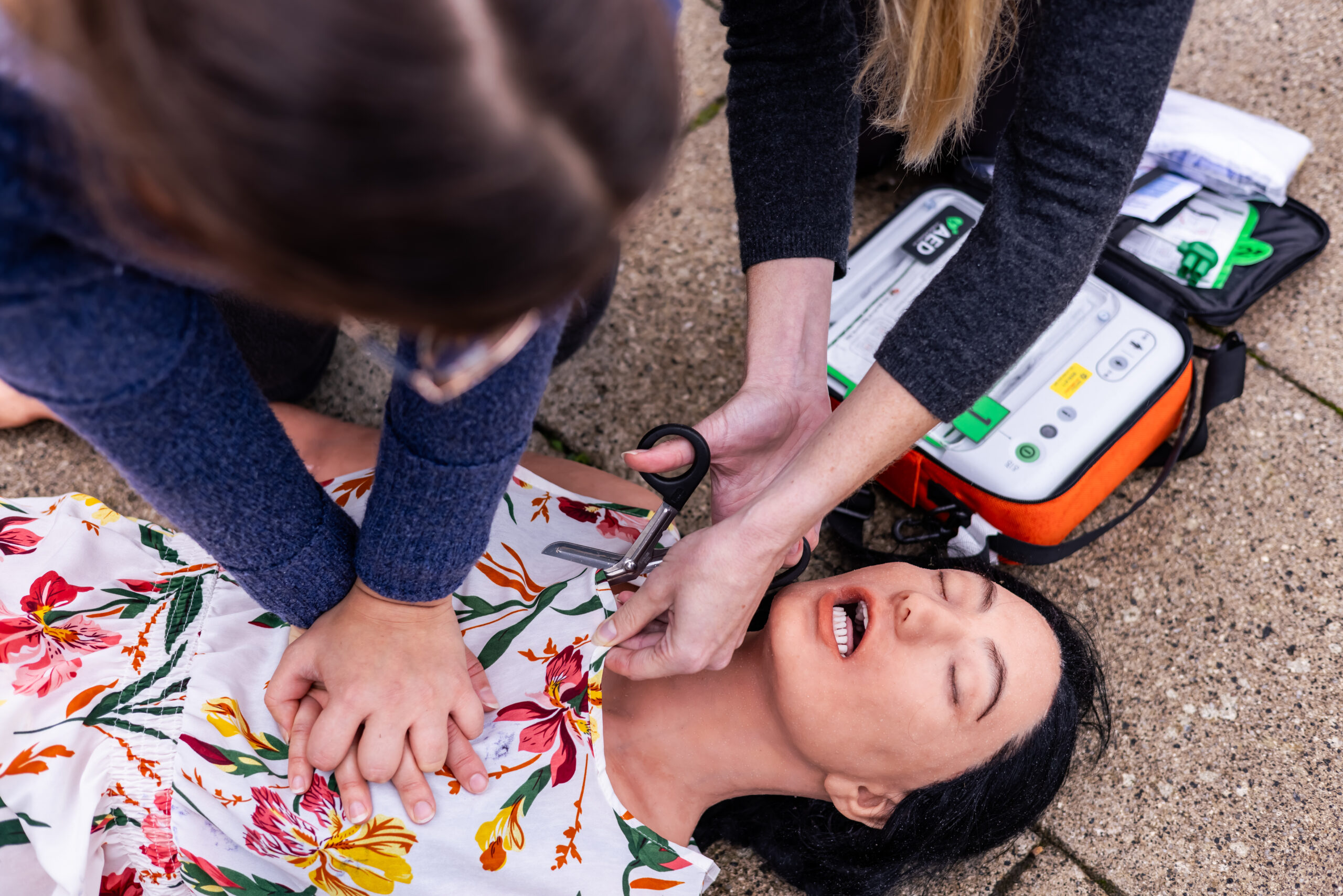
Cut or remove clothing so that pads can stick to bare skin. This includes any bras if necessary. If the chest is wet, wipe it dry. Some AED packs include a small razor, use it to shave any chest hair where the pads will be applied – this will help them stick properly and work effectively.

Step Three: Attach the pads

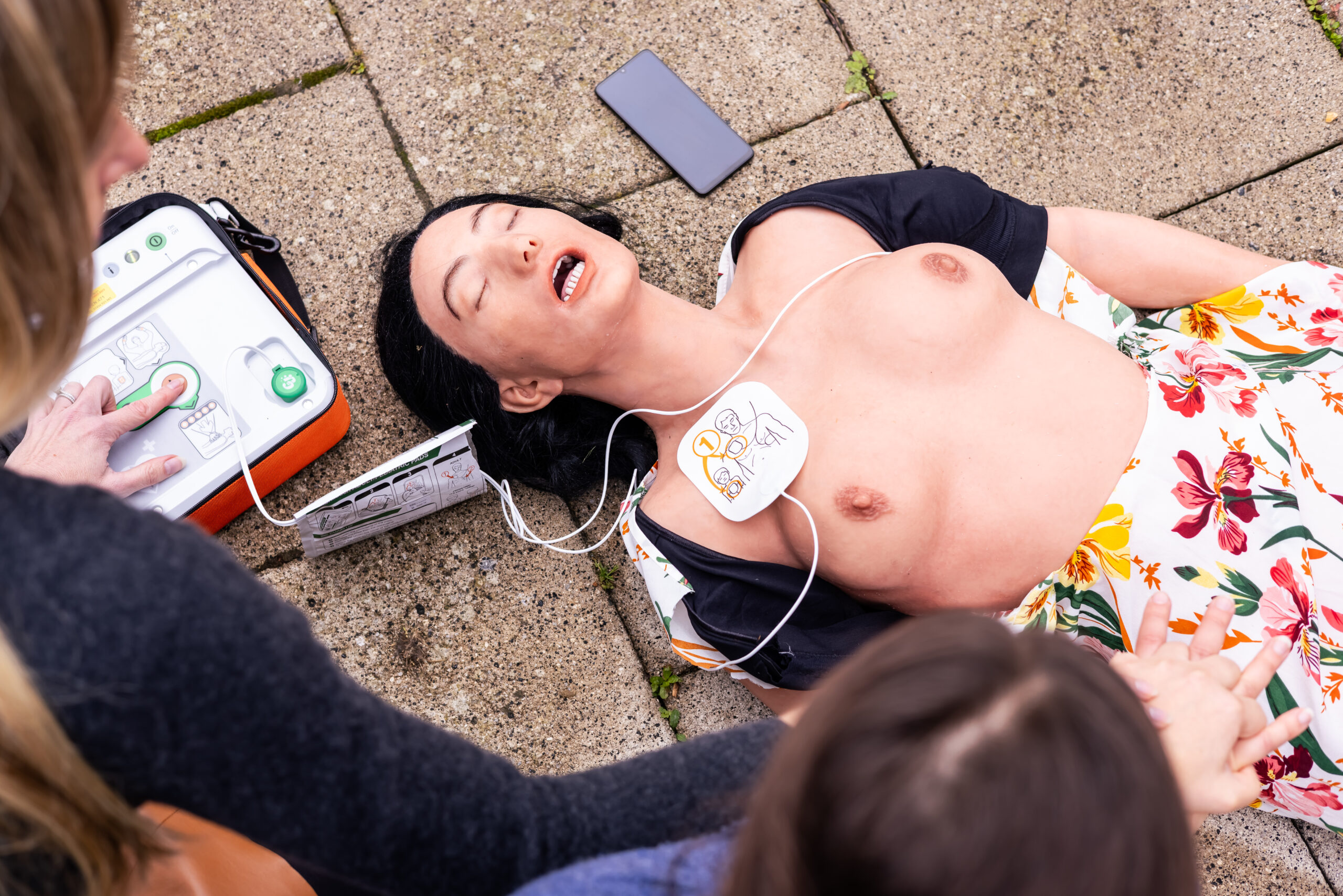
Place the pads exactly where the pictures on the AED show. One pad usually goes on the upper right chest, and other on the lower left side.

Step Four: Stand clear

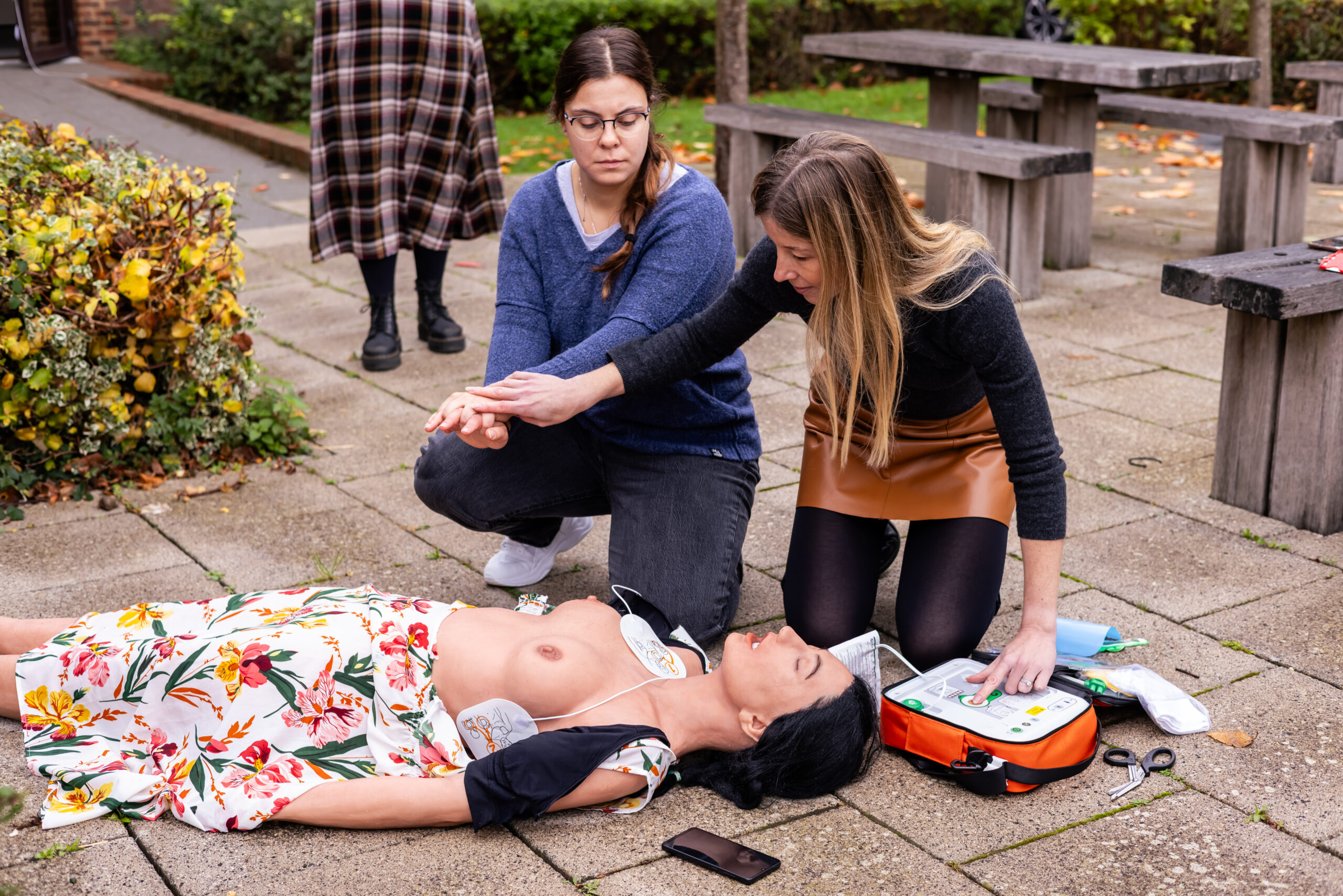
The AED will analyse the heart rhythm and tell you if a shock is needed. Make sure no one is touching the person when the shock is delivered.

Step Five: Continue CPR

After a shock, or if no shock is advised, continue CPR as instructed by the AED until the ambulance arrives or the person shows signs of life.

You can give someone the best chance of survival, simply by following instructions from the AED. Don’t be afraid to take action. Without CPR and defibrillation, a person in cardiac arrest will die.

Bystanders expose chest of CPR manikin in order to apply AED defibrillator pads
A female CPR manikin showing where defib pads should be placed.
Bystander preventing anyone from touching the patient when AED shocks delivered during a cardiac arrest
CPR training

Want to feel more confident?

You don’t need training to save a life but learning CPR can help you feel more confident if an emergency happens.

Our free CPR workshops are open to everyone and led by experienced trainers. You’ll learn the key steps of CPR, how to use an AED, and what to expect in a real emergency.

View the upcoming workshops below and book a place that suits you.

CPR: Your questions answered

CPR stands for cardiopulmonary resuscitation.

Simply put, CPR is what you do when someone’s heart stops and they stop breathing.

CPR means doing firm chest compressions to help pump blood around the body. This keeps vital organs, especially the brain, supplied with oxygen until emergency services arrive.

You don’t need medical training to do CPR. If you call 999, the call handler will guide you through what to do, step by step.

Starting CPR quickly can save a life.

If someone’s heart stops, they will collapse and become unconscious. They won’t respond if you speak to them or shake their shoulders.

They may not be breathing at all — or they may make noisy, gasping or irregular breaths. This can look worrying, but these are not normal breaths.

The key signs are:

  • They are unconscious
  • They are unresponsive
  • They are not breathing normally

If you’re not sure, call 999 straight away and start CPR. It’s always better to act than to wait.

In the UK, fewer than one in 10 people survive an out-of-hospital cardiac arrest.

But survival rates are much higher when:

  • Cardiac arrest is recognised quickly
  • Bystander CPR is started early
  • An AED (defibrillator) is used before the ambulance arrives

In these situations, a person’s chance of survival more than doubles. Your actions in the first few minutes can make a lifesaving difference.

Yes. Hands-only CPR (chest compressions without rescue breaths) is very effective, especially in adults.

When an adult suddenly collapses, there is usually still enough oxygen in their blood for the first few minutes. Chest compressions help keep that oxygen moving around the body, buying vital time until help arrives or an AED is used.

Rescue breaths can help, but you do not have to give them. If you’re not trained or don’t feel comfortable, hands-only CPR is absolutely the right thing to do.

For children or drowning incidents, rescue breaths are more helpful but compressions alone are still far better than doing nothing.

You do not need training to save a life. If you call 999, the call handler will talk you through exactly what to do.

If you’d like to feel more confident, there are easy ways to learn:

Any training is helpful but lack of training should never stop you from helping.

It is extremely unlikely.

In the UK, there has never been a successful court case against someone for trying to save a life with CPR.

If you act in good faith and do your best to help, the law and the courts are on your side. They look positively on people who step in to help others in an emergency.

An AED (Automated External Defibrillator) is a device used when someone’s heart stops because its electrical system has gone wrong.

The AED delivers a controlled electric shock that can help restart the heart’s normal rhythm.

AEDs are compact, portable, easy to use and guide the operator through the process with prompts and commands. The AED analyses precisely the individual’s heart rhythm and will only deliver a shock if it is required. 

AEDs are very reliable and will not allow a shock to be given unless it is needed. They are extremely unlikely to do any harm to a person who has collapsed in suspected Sudden Cardiac Arrest. They are safe to use and present minimal risk to the rescuer, provided the instructions are followed. These features make them suitable for use by members of the public with little or no training. 

AEDs have been used by untrained people to save lives. Clear, spoken instructions and visual illustrations guide users through the process. Lack of training should not be a barrier to someone using one. If a person is in cardiac arrest, do not be afraid to use an AED. 

Doing something is better than nothing. Without CPR or defibrillation, a person in cardiac arrest will not survive.

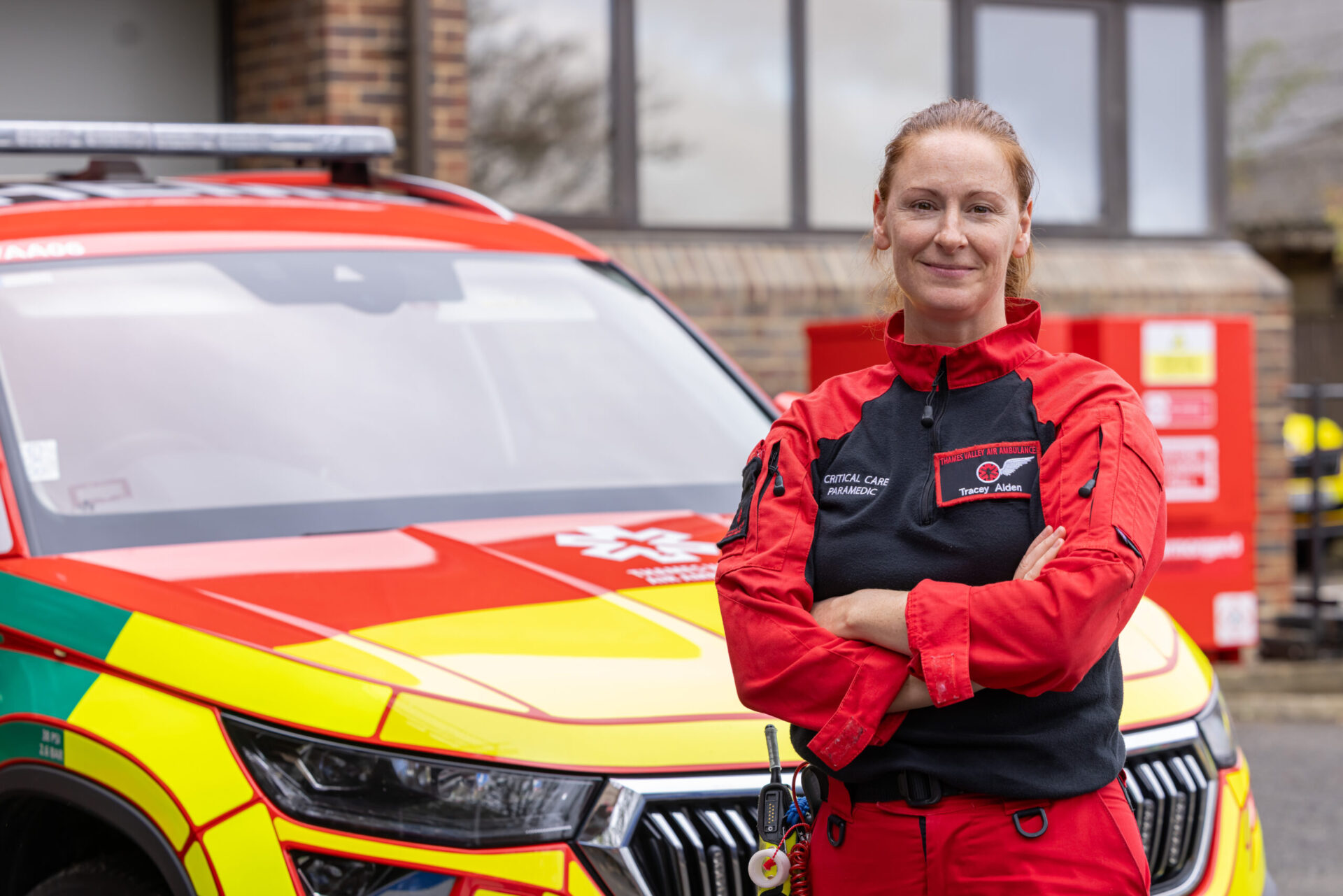
Tracey, Critical Care Paramedic