
Explore our frequently asked questions below. Can’t find the information you’re looking for? Get in touch via the contact information below.
Thames Valley Air Ambulance
Stokenchurch House
Oxford Road
Stokenchurch
HP14 3SX
FAQs
Explore our frequently asked questions below. Can’t find the information you’re looking for? Get in touch via the contact information below.
Thames Valley Air Ambulance
Stokenchurch House
Oxford Road
Stokenchurch
HP14 3SX
The Chain of Survival describes a sequence of steps that together maximise the chance of survival following cardiac arrest.
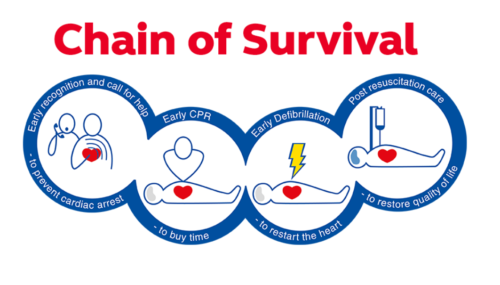
Figure 1: Chain of Survival
Like any chain, it is only as strong as its weakest link. If one stage is weak, the chances of successful resuscitation are compromised.
When the heart stops, blood supply to the brain also stops. The individual will collapse unconscious and will be unresponsive.
Breathing also stops, although it may take a few minutes to stop completely. For the first few minutes, the individual may take noisy, infrequent, or gasping breaths.
The key features of cardiac arrest are therefore someone who is unconscious, unresponsive, and NOT BREATHING NORMALLY. Noisy, infrequent, or gasping breaths are NOT normal breathing.
If you have any doubt call 999 immediately and start CPR.
Compression-only CPR describes the performance of uninterrupted chest compressions without rescue breathing. In many adults who suffer a cardiac arrest, the heart stops abruptly; breathing will have been normal (or nearly normal), so the blood should be well-oxygenated.
In this situation, compression-only CPR may be effective for the first few minutes after the heart stops. This may provide time for the emergency services to arrive or an AED to be collected. Ultimately the oxygen will be used up and rescue breaths are required to give the individual the best chance of survival.
Where cardiac arrest is caused by lack of oxygen (as in drowning and most arrests that occur in children) compression-only CPR will be much less effective.
Chest compression alternating with rescue breaths is the ideal first aid procedure, but for untrained bystanders or those unwilling to give rescue breaths, compression-only CPR (hands only) is a useful and effective alternative.
If bystanders who witness a cardiac arrest perform CPR, sufficient blood containing oxygen will reach the brain, heart, and other organs to keep the person alive for several minutes. CPR by itself will not restart the heart, but it ‘buys time’ for the emergency medical services to reach the scene. Effective CPR more than doubles the chance of someone surviving a cardiac arrest.